February’s Title Pick for Children: Trash by Andy Mulligan
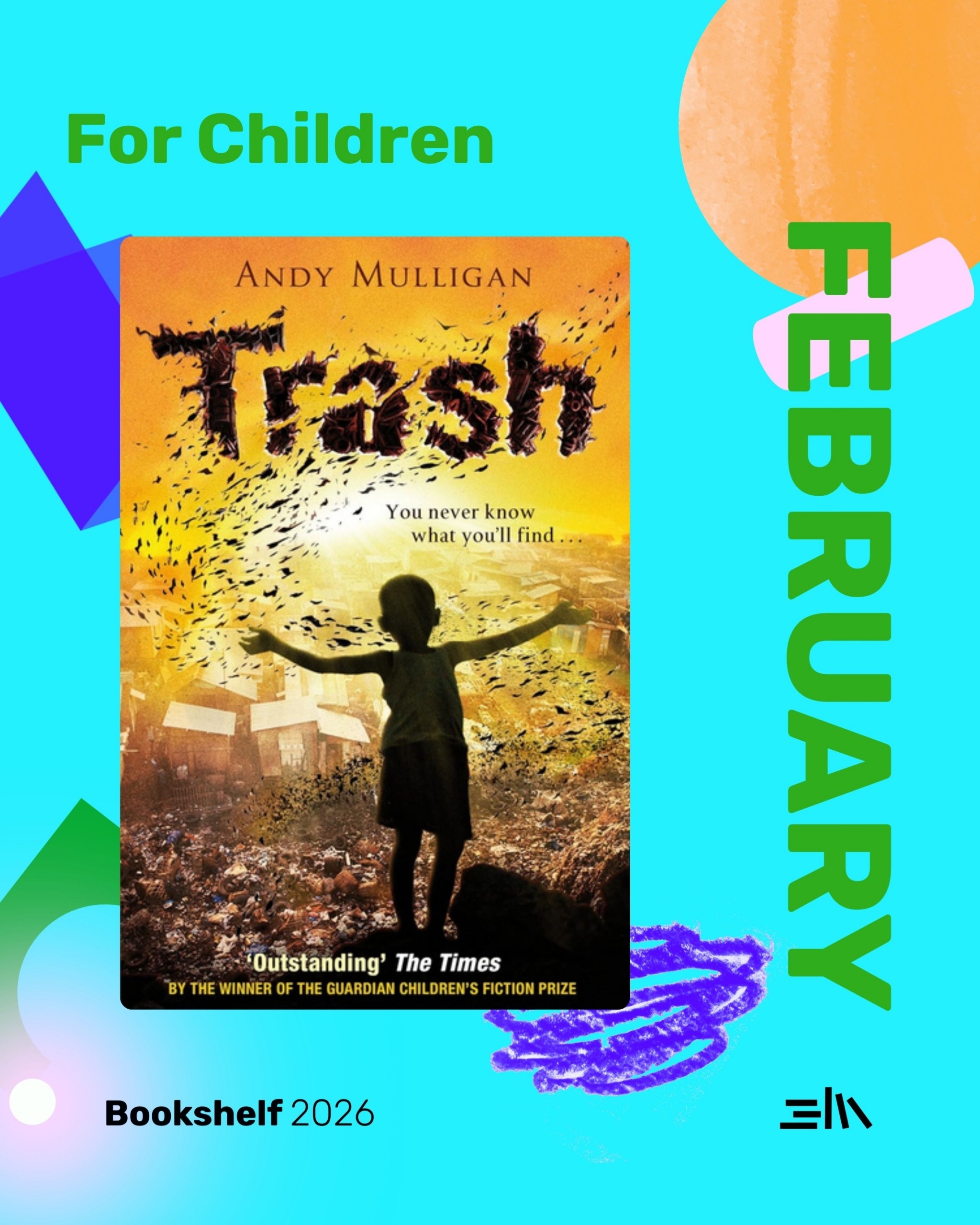
Through our Bookshelf this year we are exploring the different places that people call home. From the very beginning of Andy Mulligan’s Trash, we are confronted with a ‘home’ that most people could hardly imagine. It’s dirty, smelly, dangerous, and in many ways, a dead-end trap. Fourteen-year-old Raphael makes his home and his living on a huge dumpsite called Behala - he picks through the rubbish in search of anything he can use or sell, alongside adults older than him who have spent their lives doing the same. He sleeps in a hut made of bamboo and string, built among the piles of rubbish, alongside with his auntie and many others.
Behala is based on a real place in the Philippines, and Raphael’s way of life was true of many thousands of children when Andy Milligan wrote this book. But there is no time for readers to wring their hands at the conditions we are witnessing - the action of the story starts straight away as Raphael discovers a bag containing a wallet of money, a map and a key. This draws him and his friends into a perilous adventure - the police want this bag and its contents as it has the potential to bring down a greedy, double-dealing politician and expose lies and corruption more rotten than Behala’s piles of trash.
With Raphael when he makes this life-changing discovery is Gardo:
Gardo’s fourteen, same as me. He’s thin as a whip, with long arms. He was born seven hours ahead of me, onto the same sheet, so people say. He’s not my brother but he might as well be, because he always knows what I’m thinking, feeling – even what I’m about to say.
As the story continues it’s clear what ‘home’ really is for Raphael - it is Gardo, and later his other friend, Rat. The boys share a kind of unspoken secret language, and are fiercely protective of one another. They are clever, good at reading people and thinking ahead - the adults around them seem slow-moving, simple and naive in comparison.
The boys’ relationship and their tenderness to one another is the only secure and steady thing in their lives. This, and their instinctive sense of morality and justice - as well as the edge-of-your-seat, high stakes plot – keeps you reading, though it’s sometimes hard. There’s violence and brutality, and the boys’ adventure takes them (and the few adults who help them) through very dark places.
But the ending is triumphant, and throughout the story, hopefulness, kindness and joy persist. There’s a brilliantly cathartic scene when the boys use the sheer number of the children like themselves, living on the streets of the city, to outwit the police:
We ran then, through the kids that had come to see us, to help us, and they clustered around – they knew we were running because there’s not many kids that haven’t had to do the same thing – and they were wild for us. We all ran together. We found stairs down, and everyone was screaming and laughing, shouting to their friends, so suddenly we were a mighty crowd, pouring into the hallway. It saved us, I swear.
Trash doesn’t attempt to prettify Raphael’s home, and the terrible odds against him ever escaping it, or the way he and his friends are viewed and treated by others. It might not be suitable for younger readers, but any reader over nine-years-old will enjoy the energy and tension of the story, and find the charm and humour of the storytellers unforgettable.
By Frances Macmillan (Literature Engagement Lead at The Reader)
Share
Related Articles

September’s Title Pick for Adults: Homegoing by Yaa Gyasi
"This a novel about keeping in touch with home, and our roots and heritage, through difficult circumstances. It tells the...

September’s Title Pick for Children: Anne of Green Gables by L.M. Montgomery
Revisiting Anne of Green Gables feels like opening a time capsule. This was a childhood favourite of mine and rereading...
August’s Title Pick for Adults: The Pilgrim’s Progress by John Bunyan
Each time I re-read this opening paragraph from The Pilgrim’s Progress, I am struck by how immediately I am taken...