From Jane Davis: Remembering Angie
‘Labour well the Minute Particulars, attend to the Little-ones’, William Blake
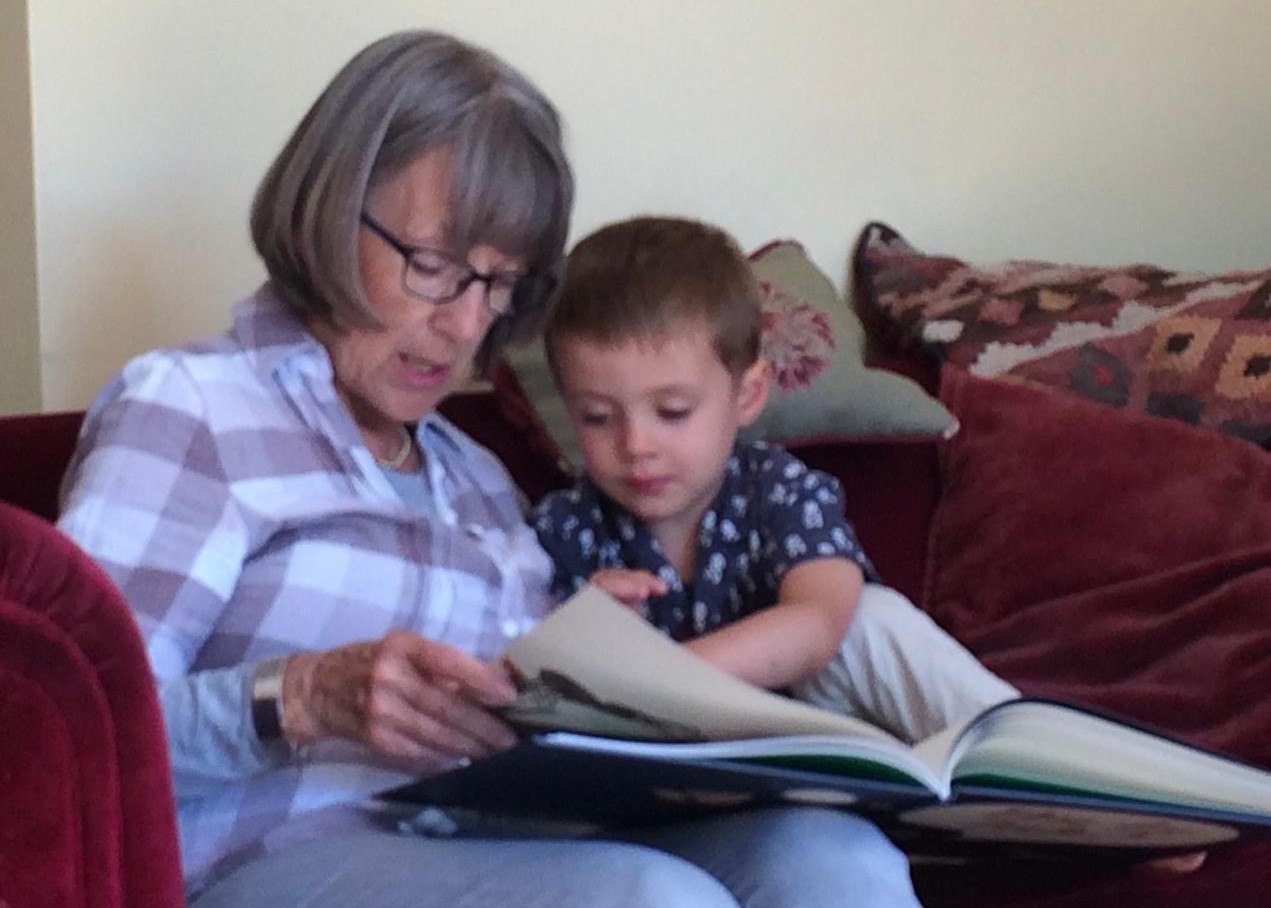
Dr Angela Raeside Macmillan, the creator of the anthologies in the A Little Aloud series, was one of the founders of The Reader. Her attention to the details of kindness became part of our Shared Reading DNA.
She died in the company of her loving family on Thursday 11 June 2026 at Clatterbridge Hospital Liverpool. She had lived with a terminal cancer diagnosis for ten years, through a characteristic determination to find good in each day.
Brave, tough, even stubborn, these elements of her character got her through some very hard times. She could be, to use what seemed her most threatening word, ‘cross’ with the blows life rains on us all. But the endurance of those last ten years was due more to a decision to look for joy wherever it might be found—her later-life love, Graham, her children and grandchildren, poems, dogs, friendship, roses, a good novel, the morning sky, an almond croissant, cow parsley, each year’s first new hawthorn leaf at a particular bit of hedge on the Wirral Way, loud singing in the car.
Everyone who knew Angie recognised the unique quality of focused intelligent sympathy she brought to both her relationships and her reading. I felt this when I first met her, in one of my Continuing Education classes in Liverpool’s Abercromby Square. I went home and told my husband Phil: ‘there was this great woman there . . .’ I think we read a poem by Alice Meynell that night, but I can’t remember/find it. Angie would have been able to. When was this? My son Ben was 3 or 4, I think, and that would put our meeting at 1988-9.
Always a reader, that literature class got her into attentive literary study and in 1990 she signed up for an MA in Victorian Literature, and soon began teaching alongside me in the Department of Continuing Education (CE) at the University of Liverpool. Later she became the departmental organiser for CE in English Literature, an administrative role she performed dutifully but without relish, as her great gift was always reading and the teaching of reading. By 1998 she had completed her Ph.D. On graduation day she made her friends a celebratory lunch and served, among other delicious things, lobster salad – a first for me.
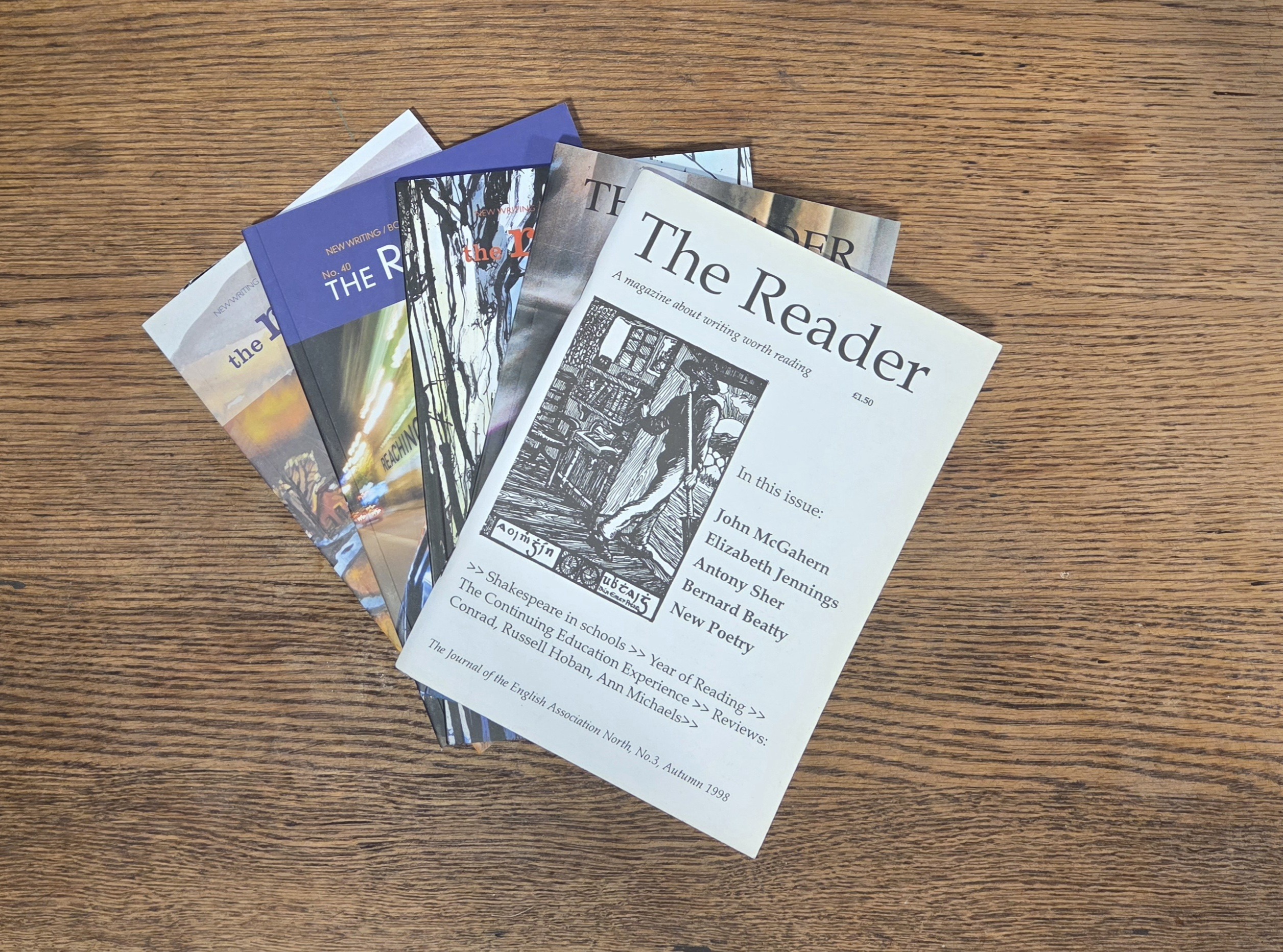
In 1997, along with Dr Sarah Coley, Angie and I founded The Reader magazine. This was the birth of what has become The Reader. We created the magazine to show what was happening in our literature classes. And what was happening was what would become Shared Reading: attentive, slow, personal reading. As the magazine found its feet, the University Vice-Chancellor gave us a tiny office at the back of 19 Abercromby Square, a room impossible for visitors to find, with a barred window which faced the Physics Department bins, with room for three computers. We were incredibly happy, busy and creative in there.
When I got our first grant for ‘Get Into Reading’, Angie was the first person I asked to join me as a staff member in this project to test our way of reading in the non-university world. Along with Kate Mcdonnell and Geraldine Mair, we set up an outreach office in the Wirral - a back room, again impossible for visitors to find, with a barred window etc, at Woodchurch Leisure Centre. The aim was to develop eleven community-based Shared Reading groups.
Angie read in places as diverse as a Wirral based LGBTQ+ Drop In service, the Leasowe Millennium Centre and The Lauries, as well as – for over a decade – Hoylake Cottage Hospital in Dementia Care. It was here, reading week in and week out, that she began to conceive of A Little Aloud, an anthology that we could all use, based on what she herself had seen work so well with so many different people.
Many years later, again at Hoylake, a woman she had read with for some years in a group, now bedbound, asked Angie to read her through her death, and Angie did that, reading Wordsworth to the dying woman for many hours. How wonderful that the last thing you might hear would be Angie’s voice sharing Wordsworth’s poetry.
Angie made a strong reading friendship with Sandie, a troubled, illiterate single mum whose children were in care. They read Jane Eyre together, and I remember her telling me how much Sandie had loved the Sharon Olds poem ‘I Go Back’. Through their reading friendship, Sandie learned to read. When her children came back to her, we all read together one summer in Birkenhead Library, the children helping their mum with difficult words. Many years later I met Sandie in the street and she said, ‘How’s Angie? Tell her my house is full of books!’
It was meaningful great literature that Angie used to connect to Sandie and to so many others. She organised ‘Swaps’ for The Reader for 17 years, a weekly email where Reader Leaders could share the poems that had worked best for them. It always ‘made her cross’ when people sent in poor-quality poems, however much the group had enjoyed them, because her commitment was always to serious reading. She knew how hard it was to find the right thing to read in a group, and she also knew, from her own open-minded, eclectic, wide-ranging reading life and years of reading with groups and individuals, that it was worth the extra effort to find and read something of real quality. That, too, was part of the DNA she poured into The Reader.
That is what lay behind her three A Little Aloud anthologies: instead of searching for readings to take to groups, Reader Leaders could use the books to find some prose and a poem to read each week. The books were the result of many hours of careful work and collaboration and were some of the proudest achievements of her working life.
Angie stood back from work during the first cancer treatment period, but by the time we set up our second office, on the first floor of the University’s semi-abandoned 19 Abercromby Square, she was working flat out on the magazine, the anthologies, and Hoylake Cottage Hospital, with that never-ending, tough, loving, friend-support she gave me through all my years of leading The Reader.
She shared an office with Chris Catterall, then a young business economics student, who amused Angie by having a Boost bar and bottle of Lucozade as a hangover-curing breakfast. Chris would eventually become our Business Manager (and go on to lead the public service innovation organisation Capacity). They were an odd pairing, (‘the poshest person I’ve ever met,’ said Chris) but a happy and productive one, too. Our Friday lunches in the back room, where Angie’s salad bowl was always a feature, were tasty, educational in the broadest possible sense, and hilarious. Chris wrote to Angie as she died, reminding her how much of what she taught him went into his work. It’s all in the loving detail.
You could always ask Angie for a book recommendation, or for a poem on some specific issue or subject. Weeds? That Hopkins poem, ‘Inversnaid’ . . . Old age? Try Tennyson’s ‘Ulysses’ or ‘Tithonus’ . . . Fireworks? There’s that David Constantine poem, ‘The Vicar’s Firework Show’. . . . Morning sun? Herrick. When you were going through tough times she always gave a little gift of love, the ‘treat’ (as she called it) of a book or a baked custard, a poem or a picture on a postcard. Her friends and colleagues learned from this.
As she lay dying, I listened with her as Phil read from The Woodlanders by Thomas Hardy, and it was beautiful to see the persistence of self, as she raised a hand to comment on a sentence, a character, or Hardy’s brilliant picturing. Her singular reading focus was a capacity that stayed with her to the end.
Angie was a powerfully sympathetic, interested, encouraging and (above all) loving mother, grandmother and partner to Graham; a terrific reader, a wonderful cook and as I can testify, the World’s Best Friend. To adapt a sentence from The Woodlanders, she was a good woman and did good things. She will be mourned and missed by everyone who knew her. But because of what she put into The Reader, everyone doing The Reader’s work can say with E.E. Cummings:
i carry your heart with me (i carry it in
my heart) i am never without it (anywhere
i go you go, my dear; and whatever is done
by only me is your doing, my darling)
The family plan a small private funeral, but there will be a celebration of Angie's life in the autumn, date to be announced.
Jane Davis, June 2026
Share
Related Articles
October’s Monthly Stories and Poems
There are two memoirists with Nigerian heritage in this months pack, each reflecting on what their family and cultural histories...
October’s Title Pick for Adults: Anna Karenina by Erin Carlstrom
My groups experience of reading Anna Karenina made me think about curiosity, and what part that plays in choosing what...
October’s Title Pick for Children: The Skull by Jon Klassen
Jon Klassen's 'The Skull' ticks all these boxes, and is a must read for this time of year. The low...