August’s Title Pick for Adults: The Pilgrim’s Progress by John Bunyan
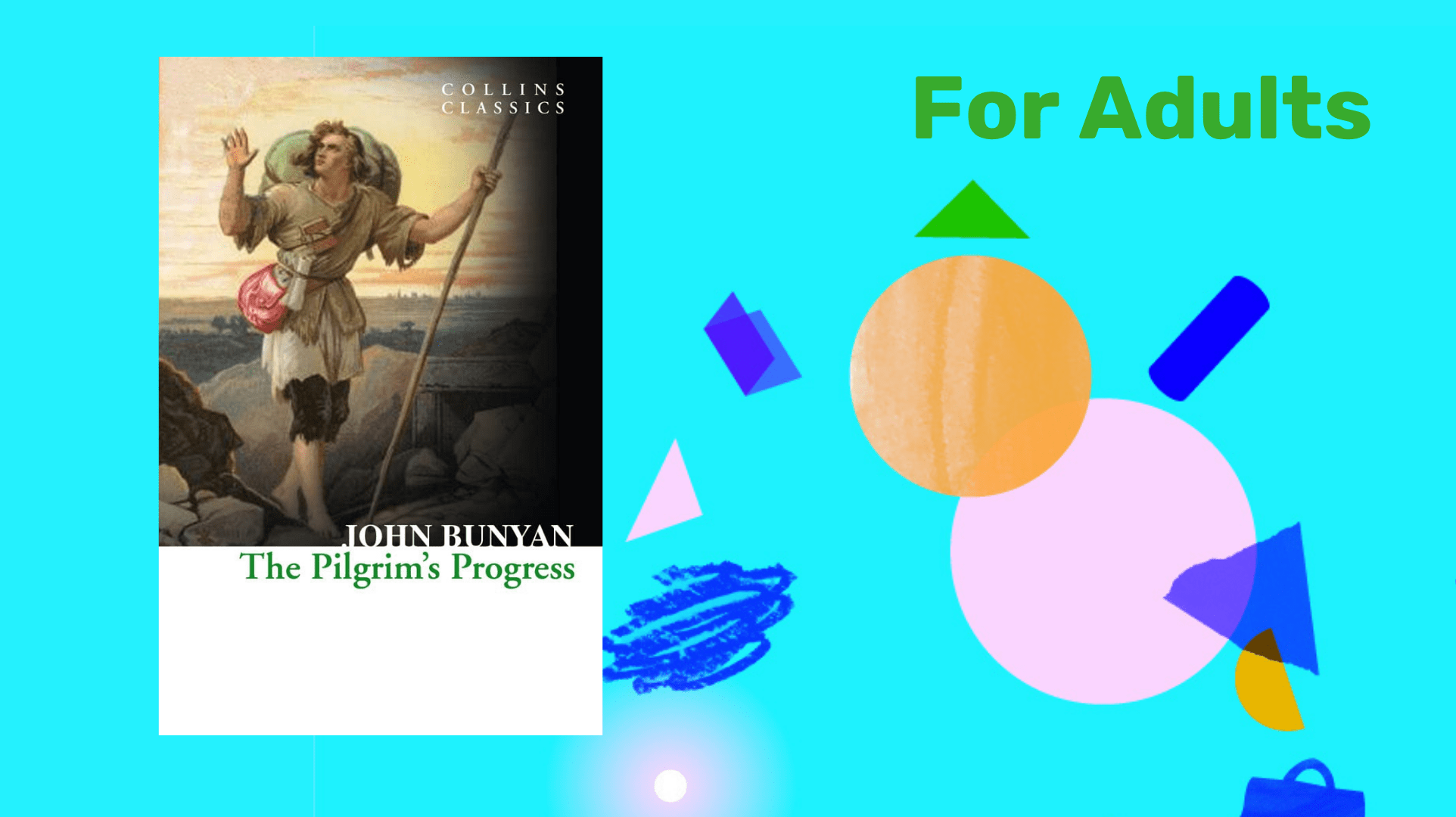
‘As I walked through the wilderness of this world, I lighted on a certain place where was a Den: and I laid me down in that place to sleep: and, as I slept, I dreamed a dream. I dreamed, and behold, I saw a man clothed with rags, standing in a certain place, with his face from his own house, a book in his hand, and a great burden upon his back. I looked, and saw him open the book, and read therein; and, as he read, he wept, and trembled; and, not being able longer to contain, he brake out with a lamentable cry, saying, What shall I do?’
Each time I re-read this opening paragraph from The Pilgrim’s Progress, I am struck by how immediately I am taken into the world of crisis. I can very quickly relate to not only the question ‘What shall I do?’, but also the accompanying fear and panic with which the question is asked. This man, Christian, is in a highly emotional state, weeping and trembling and crying out. The question ‘What shall I do?’ speaks to moments of particular crisis in life – those life-changing moments when we need help from outside ourselves to work out where to step next, how to go forward. Imagine now how hard such a crisis would be if there was no safe place to start from, or when there’s no home to return to, when ‘home’ is actually part of the problem. So indeed: ‘What shall I do?’
Just a few paragraphs later we see Christian at home with his family, trying to explain the need to escape from a place that now seems to be doomed. And we find the question now rephrased: ‘What shall I do to be saved?’ This feels like an important detail to notice. We need to wonder what the word ‘saved’ might mean to us as modern readers, for those with faith and those without? Without a religion, does the concept of being ‘saved’ still feel relevant and, if it does, what might a ‘saved’ state look like? Saved from what, from whom? We also need to think about the role of ‘the book’ that Christian is reading in all this - ‘the book’ that Christian continues to hold throughout his journey. It is interesting to me that ‘the book’ is not referred to as ‘the Bible’. Many people will be quick of course to make that link. But I like the way there is still space to wonder, space to stretch beyond the literal roots of the novel; to ask questions like: ‘If not a Bible, what else might this book be? What kind of book might make you weep, tremble, and ‘brake out’? Why would we ever pick up such a book?’
This is certainly not a straightforward or cosy read! But this is one thing to make really clear now: if you are going to read a book like this, The Pilgrim’s Progress, either just for yourself or with your Shared Reading group, it will not be cosy. To really get the most from this unique experience, you need to bring your imagination and emotion into play. In the creative, collaborative meaning-making world of Shared Reading, we as readers can work together and make our own interpretations. Whether we are religious or not, we can wonder – when might I have encountered something like this but just not seen it written down in such terms before? This wonderful story holds many meanings and interpretations, and when we read it together we can make sense of it in many different and individual ways.
Since its publication in 1678, The Pilgrim’s Progress has been translated into more than 200 languages and has never been out of print. There is clearly much human resonance to be discovered within its pages. I feel that the resonance may partly rest in the fact that it speaks so creatively to the fundamentally human experience of finding ourselves lost, without a home, and needing to find the courage to move forward, to seek a better way to live. As one member once said to me of reading the enclosed extract, ‘I would never have picked this book up and I still don’t think I’d want to read it by myself, but I am so pleased to have read it with others and it has challenged me to rethink some of my own ideas about things.’ The story will allow you to encounter new worlds and challenges as you find yourselves travelling over a vast landscape filled with strange beings and places, and I agree with my group member – it’s a journey better explored with others, ideal for a Shared Reading setting.
I also recommend that you explore treating the people and creatures you meet along the way with Christian as sentient beings rather than ‘just’ moral ciphers. Yes neighbours Pliable and Obstinate do of course represent human characteristics, but then who has not encountered a pliable friend alongside an obstinate one? Which friend would you turn to for advice? Allow yourselves to truly feel and imagine the places you encounter in the story, rather than see them as ‘just’ moral teachings. Yes the ‘Slough of Despond’ might be read as a representation of what happens if you do not pay proper attention in life, or how it feels to be sunk in a depression, but it is also a really physically scary place of thick sucking mud which can swallow you up whole and take you underground, never to be found again.
So, happy adventures dear readers – I'm sure Christian will be pleased to have you join him. It will take a bit of effort, but from my own reading journeys with Christian in the company of Shared Reading group members, I can certainly say that it will be worth the effort. And (dare I write it) you will also have some fun along the way - for all its seriousness, this book really can also be quite funny too once you allow yourselves to step into the human story of it all. ‘O then come hither,’ as Bunyan invites us, ‘And lay my Book, thy Head, and Heart together.’
By Clare Ellis, Head of Shared Reading Practise
Share
Related Articles

September’s Title Pick for Adults: Homegoing by Yaa Gyasi
"This a novel about keeping in touch with home, and our roots and heritage, through difficult circumstances. It tells the...

September’s Title Pick for Children: Anne of Green Gables by L.M. Montgomery
Revisiting Anne of Green Gables feels like opening a time capsule. This was a childhood favourite of mine and rereading...

September’s Monthly Stories and Poems
We're continuing our year-long exploration of the theme of 'home', bringing together another selection of prose and poetry to help...